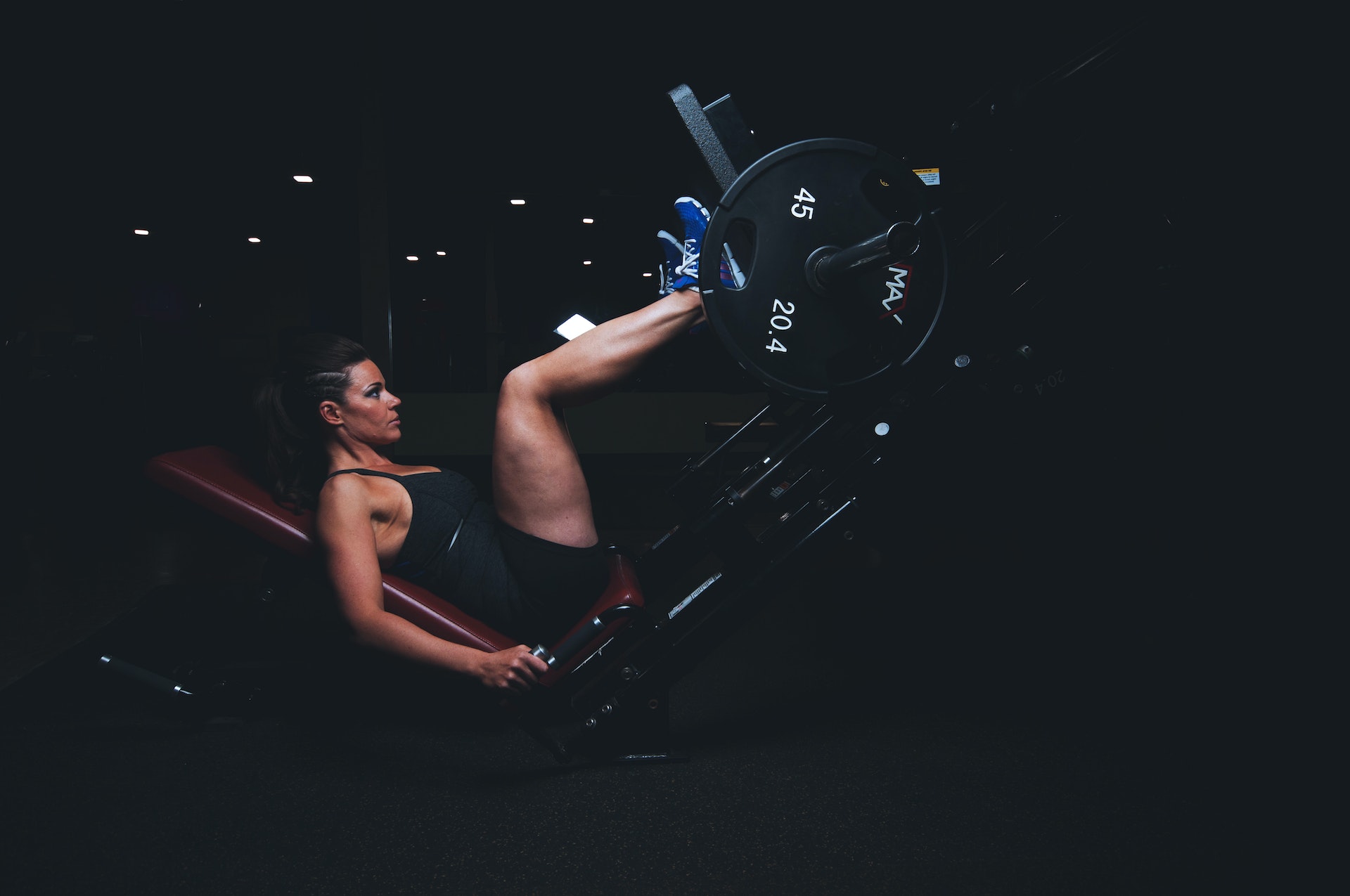
This post covers how many calories the leg press actually burns, how to do it with good form, what muscles it works, and where it fits in a balanced training programme.
How Many Calories Does the Leg Press Burn?
Calorie burn for any resistance exercise depends on three main factors: body weight, work-to-rest ratio, and total time under load. The leg press, like most strength training, is anaerobic — calorie expenditure during the lift itself is moderate, but the total cost is higher than it looks once you include rest periods, EPOC (the elevated calorie burn after the session ends), and the maintenance cost of any muscle you build over time.
Rough estimates for continuous moderate-intensity leg press work, based on MET values from the Compendium of Physical Activities:
- A 125-pound person burns approximately 90 calories in 30 minutes
- A 155-pound person burns approximately 112 calories in 30 minutes
- A 185-pound person burns approximately 133 calories in 30 minutes
In practice, almost no one spends a continuous thirty minutes leg pressing. A typical leg press session involves three to five working sets of eight to twelve reps each, with one to three minutes of rest between sets — perhaps ten to fifteen minutes of actual exercise time spread over twenty to thirty minutes total. For most people, that works out to 40–80 calories during the session itself.
That is not a lot compared to thirty minutes of running. But three factors make this number misleading on its own:
- EPOC. Heavy strength training elevates resting metabolic rate for hours afterward as the body recovers — adding perhaps another 25–50 calories of expenditure beyond the workout window.
- Muscle is metabolically active. Each pound of lean mass burns roughly 6 additional calories per day at rest. Building leg muscle through consistent leg press work compounds into meaningful daily expenditure over time.
- Movement quality. Stronger legs make every other physical activity — walking, climbing stairs, cycling — easier to sustain and more frequent.
For an estimate calibrated to your specific weight and session length, use the CalorieDetails Calories Burned Calculator.
Correct Form
The leg press has a reputation as a forgiving exercise, but that is only partly true. The risk of an acute injury (such as a dropped weight) is low, but poor form — particularly excessive range of motion combined with heavy loading — is one of the more common causes of lower back injury in commercial gyms. Take the form seriously.
Setup:
- Sit fully back into the padded seat with your back and head flush against the support
- Place your feet on the platform roughly shoulder-width apart, with toes pointed slightly outward
- Keep your hands on the side handles for stability
The lift:
- Brace your core and disengage the safety stops
- Lower the platform slowly toward your body until your knees reach approximately 90 degrees — no lower
- Drive through your heels and the middle of your feet to press the platform back to the starting position
- Keep your knees tracking in line with your toes throughout (not collapsing inward)
- Do not fully lock out the knees at the top — stop just short
Common mistakes to avoid:
- Lowering too far. If your lower back lifts off the pad at the bottom of the rep, your range is too deep. This creates significant shear on the lumbar spine.
- Knees collapsing inward. This stresses the knee ligaments and reduces the load reaching the target muscles.
- Pushing through the toes only. Drive through the heels and the middle of the foot to engage the glutes and hamstrings properly.
- Locking out hard at the top. Full hyperextension can hyperextend the knee joint.
Muscles Worked
The leg press is a compound exercise that works most of the major lower-body muscle groups simultaneously:
- Quadriceps (front of the thigh) — primary mover
- Gluteus maximus — primary mover, especially at the bottom of the rep
- Hamstrings — secondary, supporting the eccentric phase
- Calves — secondary stabilisers
Foot placement shifts the emphasis. A higher foot position on the platform recruits more hamstrings and glutes; a lower position emphasises the quadriceps; a wider stance increases inner thigh involvement.
Where the Leg Press Fits in a Programme
The leg press works well as either the primary lower-body lift in a session (for lifters who prefer not to squat) or as a secondary movement after squats or deadlifts. Three to four working sets of eight to fifteen repetitions, performed once or twice per week, is enough for most general fitness goals.
It is also a useful tool for working around injuries. Because the seated position eliminates the balance and core demands of free-weight squatting, lifters returning from back, hip, or shoulder issues can often continue training their legs on the leg press while other movements are restricted. As always, take medical advice if you are returning from a significant injury.
Should You Use the Leg Press?
The leg press is not strictly necessary for building strong legs. Squats, lunges, and deadlifts will accomplish the same outcome with arguably greater functional carryover. But the leg press offers some real advantages: it lets you train heavy legs without a spotter, it has a lower technical floor than barbell squatting, and it works well for high-rep volume work that would be impractical with a barbell on your back.
If you have access to one and your goals include lower-body strength or muscle development, the leg press is worth including. Use it with good form, treat the loading conservatively, and combine it with a balanced overall programme.
References
- Compendium of Physical Activities (Ainsworth et al.) — MET values used for calorie burn estimates
- Mayo Clinic — Strength training: Get stronger, leaner, healthier — Clinical guidance on strength training benefits
- American College of Sports Medicine — Resistance Training — Professional society guidance on resistance training
- NIH National Institute on Aging — Four Types of Exercise — Federal guidance on incorporating strength training
- CalorieDetails Calories Burned Calculator — Personalised calorie burn estimates for over 70 exercises