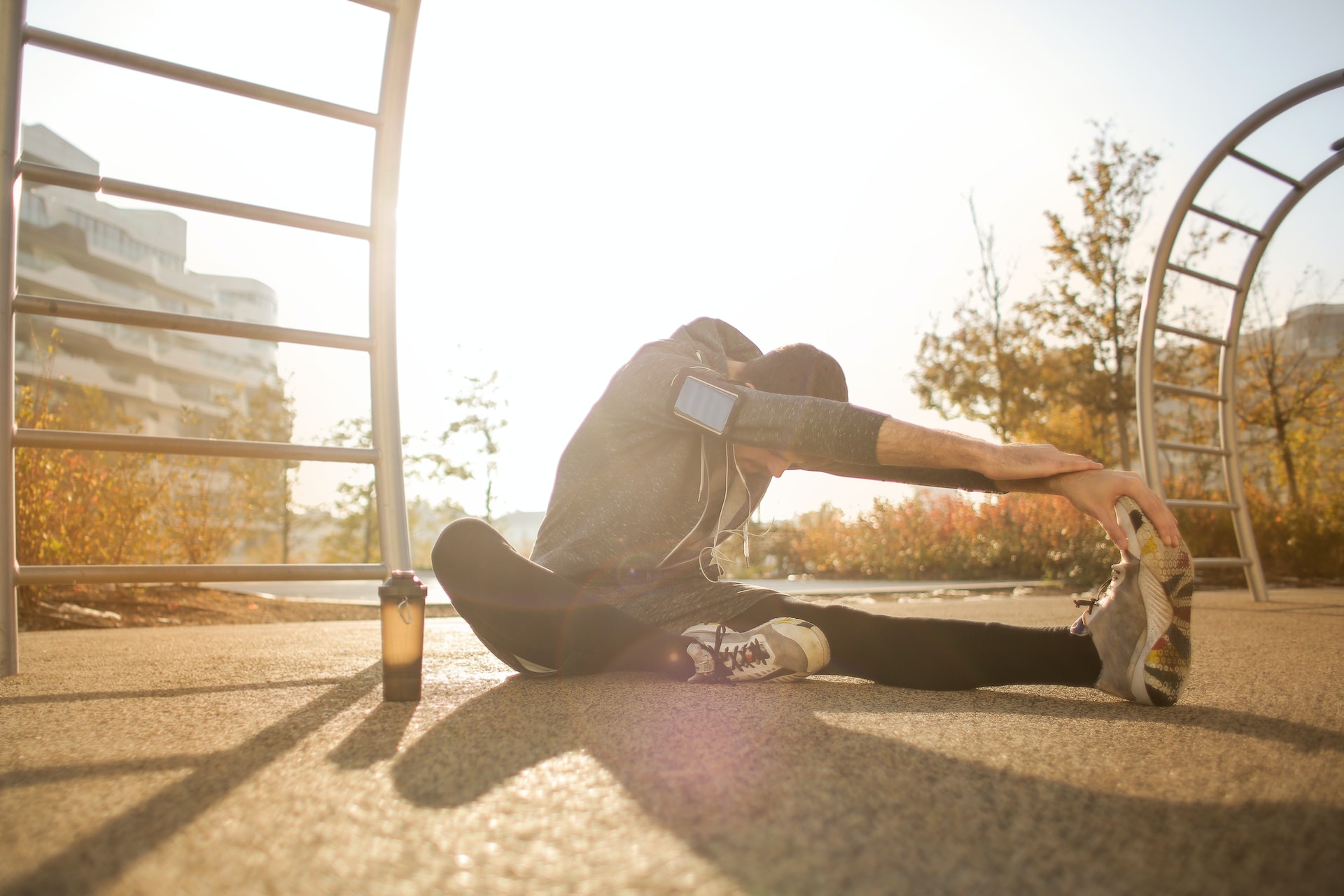
The stretches below target the major muscle groups worked during most lower-body training: quadriceps, hamstrings, calves, hip flexors, and lower back. None require equipment, and you can do them anywhere.
1. Calves and Hamstrings Stretch
- Sit on a mat with both legs extended in front of you
- Bring your right foot to the inside of your left thigh
- Reach forward toward the toes of your left foot, hinging at the hip rather than rounding your back
- Hold for 30 seconds, then switch sides
This is the single most useful stretch in the set for anyone who runs, cycles, or squats heavily. Hamstring tightness is one of the most common contributors to lower back stiffness.
2. Pretzel Stretch
- Lie on your back, then roll onto your left side
- Bend your right leg and bring the knee up toward your chest, then rest it on the floor in front of you
- Bend your left knee behind you and grab your left foot with your right hand
- Pull gently to feel a stretch through the front of the left thigh and hip
- Turn your head to the right to deepen the rotation
- Hold for 30 seconds, then switch sides
3. Hip Flexor Stretch
- Drop into a half-kneeling position with your left foot forward, knee bent at 90 degrees over your ankle, and right knee on the mat behind you
- Keep your torso upright and gently push your hips forward
- You should feel a stretch through the front of the right hip and thigh
- Hold for 30 seconds, then switch sides
For desk workers, the hip flexors get tight and short from prolonged sitting. This stretch is one of the most useful daily habits you can build.
4. Achilles and Calf Stretch
- Stand facing a wall and place your hands at shoulder height for support
- Step the right foot back about two to three feet, keeping the heel down and the leg straight
- Bend the left knee toward the wall to deepen the stretch through the right calf
- Hold for 30 seconds, then switch sides
For a deeper stretch through the lower calf and Achilles, bend the back knee slightly.
5. Downward-Facing Dog
- Start on hands and knees, with hands shoulder-width apart
- Tuck your toes and push your hips up toward the ceiling, straightening your legs
- Your body should form an inverted V shape
- Press your heels gently toward the floor (they may not touch — that is fine)
- Hold for 30 seconds, pedaling the feet to alternately deepen each calf
6. Figure-4 Stretch
- Stand near a wall or chair for balance
- Cross your left ankle over your right knee so the left leg forms a 4 shape
- Bend the right knee and sit back as if into a chair
- You should feel a deep stretch through the left glute and outer hip
- Hold for 30 seconds, then switch sides
7. Standing Quad Stretch
- Stand near a wall or chair for balance
- Bend your right knee behind you and grab your right foot with your right hand
- Keep your knees close together and your hips facing forward
- Pull your foot gently toward your glutes
- Squeeze your glutes to deepen the stretch through the hip flexor
- Hold for 30 seconds, then switch sides
Why Post-Workout Stretching Helps
The benefits of stretching are real but often overstated, so let’s be precise:
- Maintains range of motion. Regular stretching preserves the flexibility your training otherwise gradually compresses.
- May reduce next-day soreness. Evidence on stretching and DOMS is mixed, but most lifters report less stiffness with consistent stretching practice.
- Provides a deliberate cool-down. Five to ten minutes of stretching gives the heart rate time to settle and shifts the body into recovery mode.
- Builds body awareness. Regular stretching reveals tight spots, asymmetries, and lingering injuries that are easy to ignore during training.
Hold each stretch for at least twenty to thirty seconds for the muscle to relax into the position. Breathe slowly through the stretch — short, shallow breaths tense the muscles you are trying to release. Avoid bouncing or jerking. If a stretch feels sharp rather than mild, ease off.
If you have a specific injury, an unusually tight area, or chronic pain, get it checked by a physical therapist before assuming stretching alone will fix it. Stretching is a useful tool, not a substitute for proper assessment.
References
- Mayo Clinic — Stretching: Focus on flexibility — Clinical guidance on stretching technique and benefits
- American College of Sports Medicine — Flexibility Training — Professional society stretching recommendations
- Harvard Health — The importance of stretching — Overview of stretching benefits and timing
- Static stretching and DOMS (PMC) — Research on stretching and delayed-onset muscle soreness